Looking for bricks, roofing or landscaping products?
Visit our main website.
Looking for bricks, roofing or landscaping products?
Visit our main website.
From the outside, the average person would assume all brick masonry was built the traditional way – brick-by-brick. But with modern methods of construction in mind, you now have a strategic choice to make during the design phase of your project.
So, when it comes to brick slips vs bricks, which one should you choose?
Both options achieve the authentic clay aesthetic often required by planning authorities, but they each have different structural, logistical and financial implications.
In this guide we’re comparing the two options to help you, the architects and developers, decide which construction method best suits your project and site constraints.
If you’re short on time, here’s a quick comparison summary.
| Feature | Traditional Bricks | Brick Slips |
| Weight/Load | Heavy (Requires structural support) |
Lightweight (Supported by the building frame/substrate) |
| Installation Speed | Moderate (Weather dependent) |
Generally faster (Depends on cladding system choice) |
| Site Storage Space | High (Requires space for multiple pallets of bricks) |
Low (Significantly fewer pallets required, or delivered as pre-fitted panels) |
| Aesthetic Finish | Authentic clay masonry | Authentic clay masonry |
| Performance/Fire Rating | A1 non-combustible | Slips are A1, overall rating depends on cladding system: (Mechanical Precast: A1, EWI: typically B-E) |
| Costs | Moderate | Moderate – High |
| Best For | Standard new builds Low-rise residential developments Traditional cavity wall construction |
High-rise commercial developments Framed construction (concrete, steel, timber) Refurbs on sites with restricted space |
If this comparison gives you what you need to make your decision, great!
If not, let’s examine and compare each feature in detail so you have all the information to help you choose.
As you’ll already know, product weight significantly affects the structural design of your project.
In a traditional cavity wall, the outer brick leaf is built up from the foundations and tied back to the inner blockwork for stability. It’s a common construction method, but a heavy one.
Brick slips work differently. They’re applied to a backing/carrier system which is fixed to blockwork or a structural frame, putting less load on the foundations.
This weight difference may impact your structural design.
When comparing the two side by side, brick slips are naturally much lighter than full-size clay bricks.
Slips share the same length and height measurements as full-size bricks, but are cut or moulded to approximately 15-28mm thick/wide depending on their intended use. In contrast, full-size metric bricks are 102.5mm wide, and imperials tend to be 108 or 110mm.
The weight varies depending on the manufacturing process (handmade, extruded or pressed), but as a guide, a standard full-size brick weighs around 2 – 3kgs, while brick slips are around 0.4 – 0.7kgs.
We’ve established brick slips weigh less than bricks, but we also need to consider the total weight of the finished wall.
The total weight of a brick slip façade depends on the carrier system you specify:
As there are many manufacturers who produce different systems, giving a precise square metre weight is difficult.
But to put this into perspective, a standard square metre of brickwork requires 60 bricks, and let’s say your individual brick weight is 2.6kg – that’s 156kg/m² of bricks alone. Factor in mortar and inner blockwork and the complete wall system typically reaches 250-400kg/m².
If you’re designing at height, particularly above 18m, cladding is often the more practical and cost-effective choice. Even the heaviest precast panels carry less load than a full brick and blockwork façade across multiple storeys, and installation is considerably faster too.
Brick Slips: Individual slip weight and cladding system panels tend to be lighter per square metre
Bricks: Individual bricks and a full cavity wall with blockwork is heavier than cladding in most circumstances
There are many components that contribute to the build duration of a project, from material lead times and labourer availability, to something as unpredictable as the weather. While the build is managed by the contractor, your choice of materials at specification stage can affect how long the facade takes to complete.
Comparing brick slips with bricks, brick slip cladding systems generally take less time to install than traditional bricklaying. This varies depending on the system you choose, so we’ll run through each option.
First up, traditional brick masonry.
You’ll be aware of the standard process – once the foundations and inner blocks are in place, bricks and mortar are delivered to site and the outer leaf is built up.
Without knowing the size of the build and how many labourers will be on-site, it’s difficult to put a timeframe on bricklaying alone. As a rough indication, an average size family home typically takes somewhere between three and six weeks.
That said, as we’re dealing with the lovely British weather, bricklaying is very weather dependent. Rain and frost often stop work; mortar won’t cure when the weather is wet and bricks shouldn’t be laid when temperatures drop below 3-4°C.
Installation speed varies depending on the type of cladding system used, so it’s worth understanding how each one impacts the speed of construction.
EWI Systems
Insulating panels are fixed to the substrate and brick slips are adhered over the top. Once the adhesive has set, the slips are pointed with mortar and left to cure.
Like traditional bricklaying, installing EWI systems is weather dependent. However, less adhesive and mortar are used compared to a full brick wall, so the curing time is much shorter.
Mechanical Systems
A mechanical cladding system install is done in two stages. First, metal guide railings are fixed to the structural substrate. This part of installation isn’t affected by weather, so should have no unexpected time delays.
The second part of the install is weather dependent. Depending on the system manufacturer, the slips are securely pushed, slid or clipped into the railings, then pointed with mortar. As with traditional bricklaying and EWI systems, you need dry weather conditions to point the slips.
Precast and Glass Reinforced Concrete (GRC) Systems
Of the three options, precast systems are the fastest to install on-site. Panels are manufactured and stored off-site, so once the structural backing is complete, they’re delivered to site and craned into position relatively quickly.
The trade-off is lead time. Panel production typically needs to be arranged months in advance to fit around manufacturer schedules, so early planning is essential.
Brick Slips: Usually faster than bricklaying, mostly due to curing times
Bricks: Several weeks depending on the size of the project and number of bricklayers on site
The size of a project site and its access routes can influence the decision between using brick slips or bricks in your design.
Traditional Bricklaying
You’ll need space on site to store 16+ pallets of bricks for an average size new build home. The storage area must be away from mud or standing water to prevent brick saturation issues, which can be challenging on densely populated or tight city centre sites.
Now let’s compare this to brick slips.
EWI and Mechanical Brick Slip Systems
Brick slips require a lot fewer pallets than full-size bricks – around a quarter of the volume. They’re usually packed in boxes on the pallets, which makes them easier to manoeuvre around a constrained site.
Precast Brick Slip Systems
Precast panels need little to no on-site storage space. Depending on the panel size, they’re usually delivered in batches and craned into position shortly after delivery.
Brick Slips: Well suited for sites with limited on-site storage space or restricted access
Bricks: Need dedicated on-site storage space and heavy vehicle access
For many projects, the choice of façade materials is driven as much by appearance as by structural requirements.
When deciding on brick slips vs bricks for aesthetics, the only difference between the two is what’s happening under the hood. Providing you specify a high-quality cladding system, it’s virtually impossible to tell the difference between the two at street level. Both options achieve a traditional masonry finish – one is ‘real’ brickwork, the other replicates it perfectly.
If you’re concerned about brickwork intricacies such as using a brick bond other than the standard stretcher bond, or any decorative details, you need not be.
Similarly to bricks, specially cut slips are available for corners, soldier courses and header details, so you won’t have to compromise your design if you choose to use brick slips.
A great example of a commercial project that used special cut slips is the refurb of Drury Works office buildings in London. 20,000 slips, 1,500 corners and 250 cut-and-bond angles were used with a mechanical system.
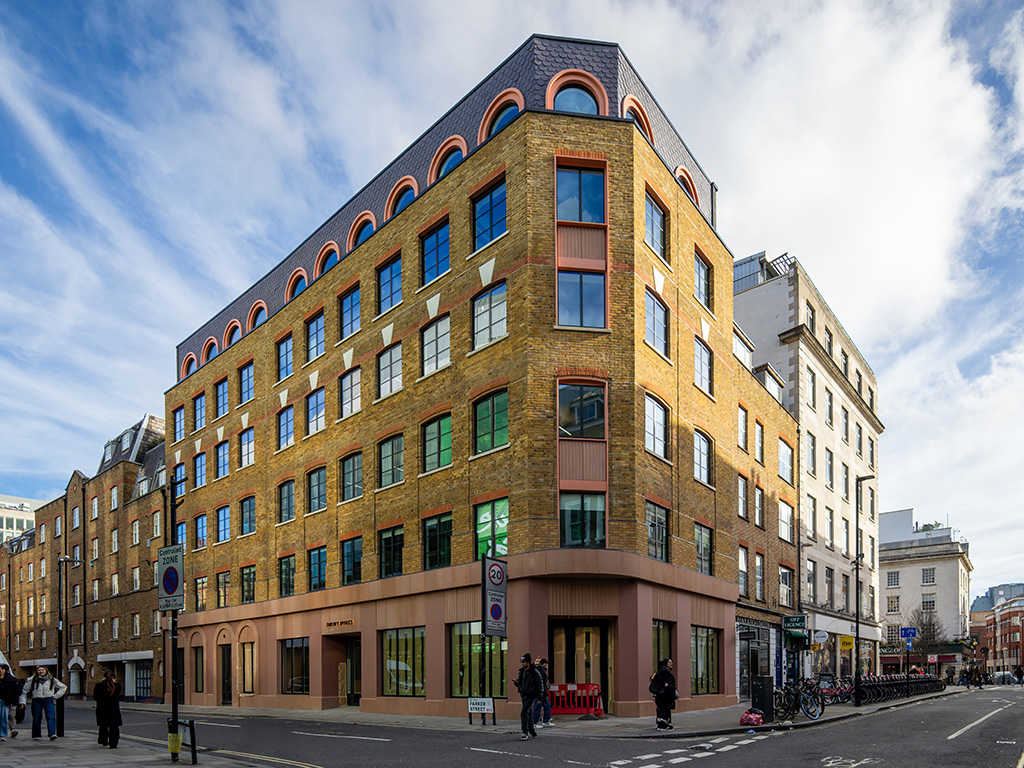
If your project requires a traditional masonry finish to satisfy planning authorities, brick slips are often accepted as a compliant alternative, as long as the slips match the required aesthetic. If you’re unsure, reach out to the local planning authority to confirm.
Brick Slips: Indistinguishable from traditional masonry and capable of replicating complex detailing
Bricks: Authentic masonry aesthetic
This is the big one for comparing bricks slips and bricks.
As you’re aware, fire and weather resistance are an essential consideration for any building project. Clay bricks are classified as A1 non-combustible under BS EN 13501-1 and carry a water absorption percentage rating in their technical data, helping you determine their suitability for your project design.
Brick slips share performance characteristics, but have important considerations depending on the cladding system you specify.
In short, yes, clay brick slips are A1 non-combustible, as classified under BS EN 13501-1.
Like full-size clay bricks, they’re fired at extremely high temperatures during manufacture, meaning they won’t contribute to the spread of fire.
When using brick slips, however, you must consider the fire performance of the cladding system you intend to specify.
As a general guide:
To summarise, clay brick slips themselves are A1 non-combustible, but you must check that your chosen backing system carries the right classification for the height and use of your building design.
Brick Slips: Slips are classified as A1 non-combustible, but the carrier system will carry its own performance rating, so must be checked with the system manufacturer
Bricks: Classified as A1 non-combustible
Clay brick slips are not waterproof, but this does not affect their durability.
Like full-size clay bricks, slips are designed to absorb and release moisture without deteriorating. Clay is a naturally porous material, so some water absorption is normal.
As with bricks, brick slips have a water absorption rating which varies depending on the manufacture method. Handmade slips tend to have a higher water absorption percentage, while extruded and pressed slips are inherently lower.
Where you need to pay attention to the absorption rating, is when you’re choosing the type of cladding system:
When specifying brick slips, always check the water absorption compatibility of the slips against your intended cladding system with the manufacturer.
Brick Slips: Have a water absorption rating which deems their suitability for each type of cladding system
Bricks: Tested for water absorption performance and have a percentage rating listed in their technical data files
On a purely like-for-like material basis, the simple answer is no – brick slips are not cheaper than bricks.
Sounds backwards, doesn’t it? We naturally assume that smaller means less clay, and less clay means they’re cheaper.
Well, that’s not quite how it works.
Brick slips are produced in one of two ways:
Add to this the square meterage cost of your chosen cladding system and pointing mortar, and it’s clear why you have an elevated cost for using brick slips vs bricks.
So, if you’re now wondering why they’re specified for large-scale and commercial projects, we need to think in terms of total project costs.
We’ve established that using brick slips is more expensive than traditional bricks, but we can’t just consider the material costs.
The reason many commercial and large-scale residential projects specify brick slips is because of the wider savings they offer across the total build.
Compared to traditional bricklaying, a brick slip cladding system can offer:
Take a multi-storey new build as an example. Installing a brick slip cladding system onto a structural frame is faster and requires less materials than building a traditional cavity wall, tying the outer leaf to the inner blockwork, supporting the weight down to the foundations and waiting for mortar to cure.
Brick Slips: Cost more than brickwork, but savings can be made elsewhere as a result of reduced load bearing and faster construction speed
Bricks: Often cheaper than brick slips and cladding systems, but the trade-off is more time required building the façade on-site
There are plenty of factors to consider when choosing whether to use brick slips or bricks for your project design. Crucially, façade aesthetics isn’t one of them.
Project budget is often the biggest focus, though we’d recommend considering wider project aspects such as site constraints, project deadlines, building height and load requirements too.
For a quick recap, here’s a general indication of when to use each:
If you’re unsure which option is right for your project, request a consultation with our team who can advise you on suitable brick slip products and system compatibility.
If this article helped you decide on using brick slips, you can request samples from our range, and our guide comparing external brick slip cladding systems can help you choose the right system for your project.